
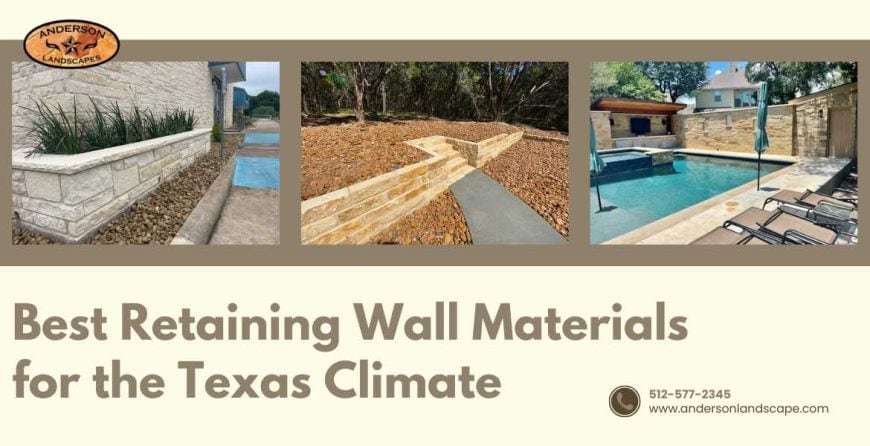
Summary
Choosing the right retaining wall material in Texas is not just about looks. Between the soft soils East of I-35 used for farming for generations and the limestone bedrock of the Hill Country, the material you choose determines if a wall stands for decades or collapses in months to years. This blog breaks down what works best for retaining walls in Austin. Find out about various materials and how they perform – so you can make the right call and appropriated vet a contractor before breaking ground.
Intro
Texas weather seems to make up its own rules as it goes. One week, you are dealing with scorching heat, the next you have flash floods, cracked soil, and a yard that looks like it has been through a war zone. If you are in Central Texas and planning a retaining wall, material choice matters more than you think. It is about durability, not just curb appeal. It is a long-term performance decision, a drainage decision, and honestly, will this thing still be standing in ten years’ time decision?
From limestone and concrete blocks to natural stone and timber, each option behaves differently in Austin’s climate. Knowing your options before hiring a landscape contractor helps you make smart decisions and avoid any costly errors.
Why Retaining Walls Fail in Texas
Most retaining wall failures in Central Texas narrow down to three things, and none of them are about the material alone.
Erosion or shifting soils
The soil in Austin erodes downhill when wet. This constant shifting creates intense pressure under the weight of the wall. If your design does not account for it, the wall will shift, lean, or buckle – no matter how good it looks on day one. While concrete, stucco and other man made materials do well in many areas of the country, Central Texas is fortunate to have the best materials native right here in place ready to be reimagined into the perfect solution for erosion prevention or terracing. Limestone in various hardness scales, colors and textures is quarried all over Central Texas and it is perfectly adjusted over millions of years to sustain in our unique environment.
Drainage
Water trapped behind a retaining wall is the single most common cause of failure. When water collects behind a wall without an exit, it creates immense pressure that can damage the entire structure. Every well-built retaining wall in Central Texas should have a drainage plan built in from the start – gravel backfill, drainage pipe, and weep holes or drainage gaps in the wall face.
Heat & Temperature Changes
The Central Texas climate is defined by intense summer heat and occasional deep freezes. It causes materials to expand and contract. Walls that cannot handle this movement develop cracks and gaps within a few years.
Key Point
Right material + bad drainage = still fails.
Wrong material + good drainage = just fails slower.
The only real answer is all three: right material, proper drainage, and correct installation.
What Does a Retaining Wall Actually Do? (And When You Really Need One)
A retaining wall is more than a design feature. In Central Texas, retaining walls do more than hold back dirt. They manage sloped terrain, protect foundations, control drainage, and turn unusable hillside lots into functional space.
You likely need a retaining wall if:
- Your yard is sloping and losing topsoil after heavy rain.
- You are creating a level patio, driveway, or lawn area on a sloped lot.
- Soil movement or runoff is threatening a foundation or structure.
- You are terracing a hillside for planting beds or lawn areas.
- Water or soil from a neighboring grade is encroaching on your property.
As the saying goes in the field: If you can’t build the Ark, we can build a retaining wall. Both are amazing! Both are designed to keep the elements exactly where they belong so your property stays high and dry.
Best Retaining Wall Materials for Texas (Quick Comparison Table)
Here is a quick comparison of retaining wall materials suited for Austin and Central Texas, before we explore each option in detail.
| Material | Durability in Texas | Maintenance | Relative Cost (Installed) | Best Use Case |
|---|---|---|---|---|
| Concrete Blocks | High | Low | Medium | Residential + commercial |
| Limestone | Very High | Low | Medium | Central Texas properties |
| Natural Stone | High | Low | High | Premium landscapes |
| Poured Concrete | Very High | Very Low | High | Heavy-duty / commercial |
| Timber | Low | High | Low | Temporary / short-term |
Note: The cost of installing a retaining wall in Austin varies significantly based on height, drainage design, and soil conditions. Exact pricing should always be confirmed with a local contractor.
Concrete Block Retaining Walls: Most Reliable for Austin
Concrete block is the most widely used solution by hardscaping companies in Texas. It is engineered for structural retention, handles soil movement well, and performs well in high temperatures without significant expansion or contraction. CMU block however is susceptible to weather and cracking from expanding water and ice damage during freezing.
Why it works
- Interlocking dry-stack systems flex with soil movement.
- Supports geogrid reinforcement for taller walls.
- Consistent sizing simplifies drainage installation.
- Available in multiple finishes that suit both residential and commercial properties.
Best For: Everything from small garden walls under two feet to engineered structures over six feet. The retaining walls in Austin that are taller than four feet usually need a permit and an engineer-approved design.
Watch out: Failures almost always arise from poor base prep or missing drainage – not the block itself.
Natural Stone Retaining Walls: Strong & Aesthetic
Natural Stone Walls are typically made from fieldstone, sandstone, or block cut limestone and lueders stone. They are among the most visually appealing choices available. In Central Texas, they are a popular choice for homeowners who want a wall that looks great while also doing its job with the highest longevity
Why it works
- Handles Texas heat with minimal expansion.
- Dry-stack installation allows natural drainage while mortared with weep holes is also excellent
- Irregular stone shapes lock together under load as well as custom cut blocks
Best For: Any and all applications where longevity and esthetics are the goal to include privacy walls, terrace retaining walls,Garden terraces, yard and bed borders, and HOA properties where appearance standards are strict.
Watch out: Dry stack stone is less sturdy than masonry mortared walls where concrete mortar further secures the locking of the stones together to create a long-term bond.
Limestone Retaining Walls: Best Local Fit for Central Texas
Locally quarried and naturally adapted to its environment, limestone is one of the most practical and cost-effective choices for Central Texas retaining walls.
Why it works
- Naturally adapted to Central Texas soil and climate.
- Excellent thermal stability.
- Drains well when installed by professionalconstruction methods
- Local sourcing keeps costs down.
Best For: Residential and light commercial properties across Austin and the wider Hill Country corridor where a natural, regionally authentic look matters.
Watch out: Requires a contractor experienced with limestone. Poor dry-stack technique leads to early failure.
Poured Concrete Retaining Walls: Heavy-Duty & Commercial
Poured concrete is the structural workhorse of retaining walls. It is not the most common residential choice here in Central Texas but can be designed and engineered to pump into a specific form unlike the preferred native stone.
Why it works
- Reinforced concrete handles high lateral pressure.
- No joints means fewer failure points.
- Ideal for complex or steep grade changes where native stone isn’t ideal due to delivery access points of the material
Best For: Commercial sites, steep residential slopes, and any application requiring a permit and engineer approval. Best fit for walls over four feet in Austin.
Watch out: High cost and zero tolerance for drainage mistakes. Poor drainage will require expensive flooding risks and pump truck water remediation.
Which Retaining Wall Material Is Right for Your Property in Central Texas?
Now that you understand how each material performs in Texas conditions, here is a simple way to match your situation to the right choice:
1. Soil Condition
Soft or shifting soil/East of I35 → Concrete base and native limestone.
More stable soil → Limestone or natural stone with mortared joints to include weep holes where necessary.
2. Project Scale
Heavy loads or commercial projects → Engineered poured concrete.
Residential landscaping → Concrete foundation and limestone or other native stone with mortared joints.
3. Budget vs. Longevity
Short-term savings often lead to long-term repairs.
Choosing the right material upfront reduces lifetime cost.
Bottom line: There is no universal best retaining wall material, only the best fit for your specific site conditions.
How to Choose the Right Retaining Wall Contractor in Austin
Material alone will not save your project. Execution matters just as much.
When evaluating the best retaining wall contractors in Austin, TX, look for
- Experience specifically in retaining walls, not just general landscaping.
- Drainage knowledge is discussed upfront. It is non-negotiable in Central Texas.
- Knowledge and native experience for walls over four feet and erosion prevention methods is key here where our climate is flashflood to drought
- Itemized quotes covering base prep, drainage, materials, and labor.
- Valid insurance and local Austin references.
Key questions to ask
- How do you prepare the base and manage drainage?
- Does this wall need a permit, and do you handle that process?
- What does your installation warranty cover?
If evaluating retaining wall contractors in Austin, a qualified professional should be able to answer these questions clearly and confidently.
Final Takeaway: What Actually Lasts in the Texas Climate?
Material matters, but drainage and installation quality matter just as much. A premium material will fail if installed poorly, but a cost-effective material can last for decades if it has a solid base and proper drainage.
If your yard is eroding or your site needs structural support, build it right the first time. Anderson Landscape designs and constructs retaining walls that perform well in Austin conditions – so your investment stays solid, and your landscape stays beautiful.
FAQs: Retaining Walls in Austin and Central Texas
What is the most durable retaining wall material in Texas?
Native stone from our local quarries in Georgetown & Jarrell. It has already sustained here for millions of years. Let’s not pretend we can create better than Mother Nature intended if it’s still perfect. If it’s lasted millions of years, it will last the life of your property.
How do you know if a retaining wall is failing?
Warning signs include leaning or bowing, soil spilling over the top or from under the base, or sections that have shifted collapsed or crumbled apart. The sooner these are addressed, the easier and less costly the fix if it is savable.
How long do retaining walls last in Texas?
Lifespan depends mainly on material and installation quality. Properly built concrete block, limestone, and poured concrete retaining walls often last 30–50 years or more in Central Texas. Wooden timber or railroad tie retaining walls typically only last about 8-10 years as they erode from wood rot and pests. Just like wood on your home should never touch the soil to prevent termites from eating it, wooden timber walls are the same. They invite pests to your property and start degrading instantly upon contact with the soil and moisture.
How do I protect my wall from harsh weather?
Check your wall regularly – especially after heavy rain. Look for cracks, bulges, or drainage issues and fix them early before they become larger problems. Remove leaves, weeds, and debris regularly to prevent moisture buildup.
Can timber work for retaining walls in Austin?
Untreated timber is discouraged by professionals in Texas as we have aggressive bugs/pests that eat and infest wood and easily transfer to your homes structure.Texas heat, moisture, and heavy rains quickly damage timber making it unsafe for stabilizing weight. Most treated wood retaining walls in Central Texas fail quickly and are not a sound investment vs native limestone alternatives.